Pectus exercises
Pectus Excavatum Workout: The Complete Training Plan and Guide
The complete pectus excavatum workout: a 3-day pillar plan, exercise library, mobility, breathing, nutrition, progression and FAQs — built around a pectus chest.

If you've searched for a pectus excavatum workout, you've probably been handed a generic upper/lower split and told to 'just bench more'. That misses what actually changes how a pectus chest looks and feels. This is the full PectusFit pillar guide — a posture-first, three-day weekly workout, an exercise library, daily mobility and breathing, a nutrition framework, an 8-week progression and a long FAQ. Run it for a single training block and you'll have done more for your chest than a year of random benching.
Why a pectus-specific workout matters
Pectus excavatum is a structural condition where the sternum is recessed into the chest wall. Exercise does not move bone — but it can meaningfully change the muscle, posture and breathing patterns around the dip. That is the part most people are actually trying to improve when they search for a pectus excavatum workout: the way the chest sits, fills the t-shirt and carries through the day.
A pectus chest tends to pair with three patterns: a tight, short anterior chest; a weak and lengthened upper back; and a shallow, upper-chest breathing pattern. A good workout for pectus excavatum targets all three at once. It prioritises upper-back work, presses from an incline, builds the shoulders for width, uses full but pain-free range, and bakes daily mobility and breathing into the routine — not as an afterthought, but as the part of the plan that actually changes posture.
The plan below is the one we run by default inside the PectusFit app. It is built for adults of any training age and assumes access to a basic gym (dumbbells, a bench, a cable or band, and ideally a chest-supported row machine). A two-day home version is included at the end.
Five principles behind the plan
- Pull more than you press. For every pressing set, do at least one pulling set. Most pectus chests are already pulled forward — adding flat bench volume on top is the fastest way to make posture worse.
- Press from an incline. The upper chest is what visually fills the area above and around the dip. Low-incline dumbbell and machine pressing builds it without forcing the ribcage into a collapsed position.
- Train the upper back hard. Face pulls, chest-supported rows, rear-delt work and band pull-aparts open the posture and balance the shoulder girdle.
- Use full but pain-free range. Never force a range that hurts around the sternum. A controlled half-range with no pain beats a forced full-range with sharp signal.
- Recover like it counts. Sleep, protein and at least one true rest day each week. Muscle is built between sessions, not during them.
The 3-day weekly plan
Three sessions, around 50–60 minutes each. Two upper-body days that emphasise back and incline pressing, one lower-body and core day. Do the daily mobility on every other day for five minutes.
Monday — Upper A (push-focused)
- Incline dumbbell press — 4 × 8 (low incline, around 20–30°)
- Chest-supported row — 4 × 10
- Standing overhead press (light) — 3 × 8
- Face pulls — 3 × 15
- Lateral raises — 3 × 12
- Band pull-aparts — 3 × 20
- Plank — 3 × 30 seconds
Wednesday — Lower & core
- Goblet squat — 4 × 8
- Romanian deadlift — 4 × 8
- Bulgarian split squat — 3 × 10 per side
- Hanging knee raise — 3 × 10
- Dead bug — 3 × 8 per side
- Calf raise — 3 × 15
Friday — Upper B (pull-focused)
- Low-incline machine press — 4 × 10
- Single-arm dumbbell row — 4 × 10 per side
- Cable fly (light, slow tempo) — 3 × 12
- Rear-delt fly — 3 × 15
- Wall slides — 3 × 10
- Side plank — 3 × 20 seconds per side
- Optional: biceps and triceps superset — 3 × 10
Every day — 5-minute mobility
- Doorway pec stretch — 2 × 30 seconds per side
- Thoracic foam-roll extensions — 2 × 8
- Cat–cow — 8 slow reps
- Diaphragmatic breathing — 10 slow nasal breaths
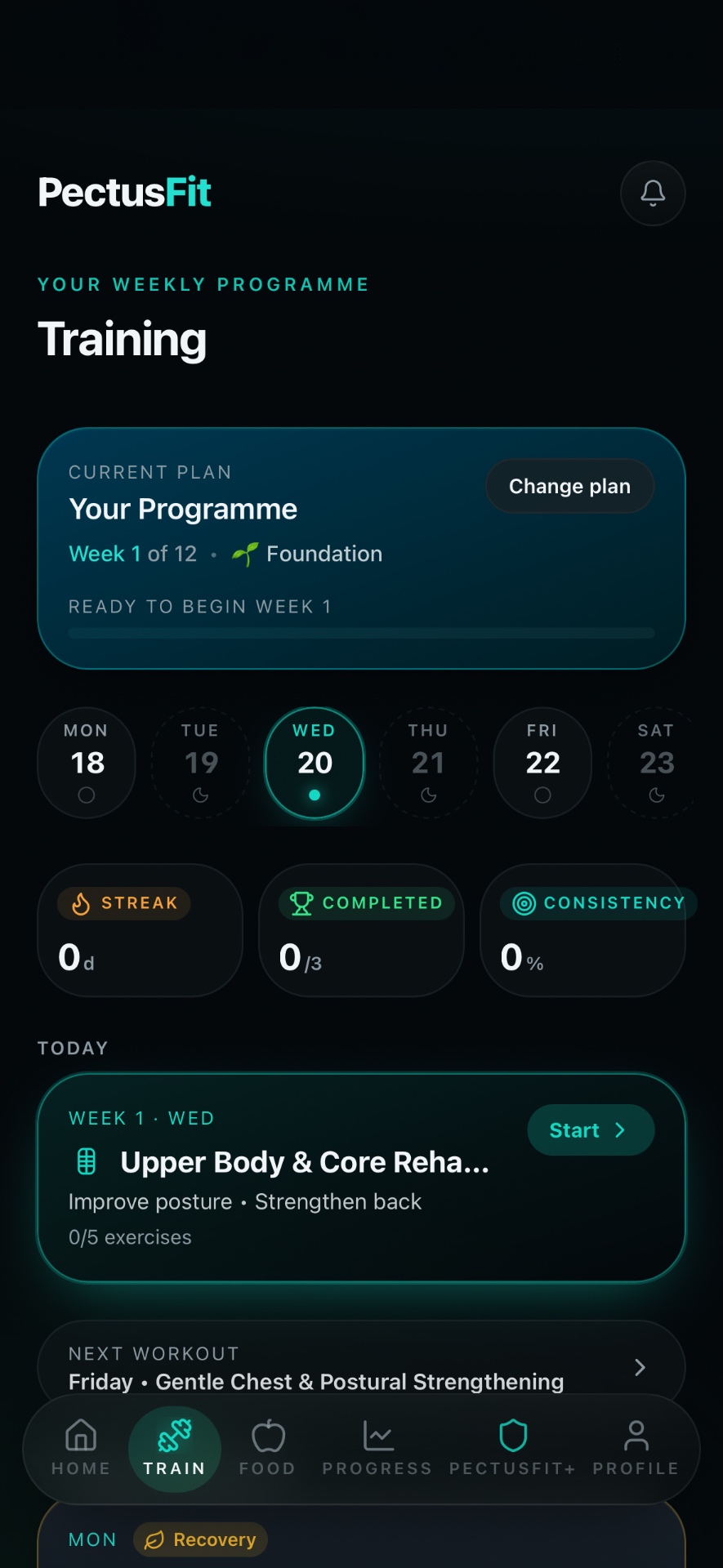
See the plan inside the app
PectusFit ships this template, the exercise library, video form cues and daily mobility as a single guided plan. You tick boxes, log loads and the app handles progression.
Exercise library: what to do and why
Incline dumbbell press
Why: the single best pressing variation for a pectus chest. The incline biases the upper pec fibres that fill the area around and above the dip. Dumbbells let each side move independently, which helps when there is asymmetry in the chest wall.
Cues: 20–30° incline, feet planted, ribs down. Lower until the dumbbells are level with the upper chest — not deeper than feels comfortable. Press up and slightly together. Stop a rep or two short of failure on most sets.
Chest-supported row
Why: the chest support takes the lower back out of the equation and lets the mid-back work in isolation. This is the row that fixes posture fastest.
Cues: pull elbows toward the hips, not the ears. Squeeze the shoulder blades at the top for a one-second pause. Slow on the way down.
Face pulls
Why: the highest-leverage exercise in this plan for posture. They train the rear delts, mid-traps and external rotators all at once — the muscles that physically pull the shoulders back.
Cues: cable at face height, rope handle, light load. Pull the rope to the eyes with elbows high. Two seconds out, two seconds back. Sets of 15–20.
Band pull-aparts
Why: a five-minutes-a-day upper-back fix. Cheap, joint-friendly and free to do anywhere.
Cues: arms straight, ribs down, squeeze the blades. 100 reps a day across the day is a cheat code for posture.
Lateral raises
Why: wider shoulders make the chest dip look smaller without ever touching the chest itself. The most underrated lift in any pectus workout.
Cues: lead with the elbows, slight forward lean, soft pause at the top. If you feel it in the upper traps, lower the weight.
Wall slides
Why: trains the scapular upward rotators in the exact pattern you need for healthy overhead movement. Excellent warm-up.
Cues: back flat against the wall, wrists and elbows in contact, ribs down. If you cannot keep contact, you have found the range that needs work.
Daily mobility and breathing routine
This is the part most generic plans skip. Five focused minutes a day does more for chest line and confidence than any single workout. The full breakdown lives in our dedicated guides:
Short version of the daily routine: doorway pec stretch (2 × 30s per side), thoracic foam-roll extensions (2 × 8), cat–cow (8 slow reps), and five minutes of slow nasal breathing with a hand on the lower ribs feeling them expand sideways.
Warm-up and cool-down
Warm-up (5 minutes, before every session): 60 seconds of easy cardio, 10 cat–cow, 10 band pull-aparts, 10 wall slides, 10 bodyweight squats. The goal is warm joints and an awake mid-back — not fatigue.
Cool-down (3 minutes, after every session): doorway pec stretch, thoracic extensions over a foam roller, and one minute of slow nasal breathing. The cool-down is where the parasympathetic switch flips and recovery starts.
Progression, deload and plateaus
Run the same exercises for 8–12 weeks before changing anything major. Variety is overrated; consistency wins.
- Week 1–2: groove the movements. Leave 3 reps in the tank.
- Week 3–6: add one rep per set each week. When you hit the top of the rep range on every set, add the smallest weight increment available.
- Week 7: planned deload. Same exercises, 60% of your usual weights, 2 sets each.
- Week 8 onwards: continue progressing. If a lift stalls for 3 weeks, swap the variation (e.g. incline dumbbell to low-incline machine) and keep going.
Nutrition for visible chest changes
Training is the trigger. Food is the building material. For a fuller upper chest and stronger posture you need enough calories and enough protein — for long enough.
- Calories: a small surplus of 200–400 kcal per day if you want to add muscle and visual fullness. Maintenance is fine if you only care about strength and posture.
- Protein: 1.6 to 2.2 g per kg of bodyweight, spread across 3–5 meals.
- Carbs: generous around training to fuel hard sets.
- Fats: enough to support hormones, around 0.8 g per kg of bodyweight.
- Hydration: water before, during and after sessions; salt food normally.
For a deeper look at programming for size with a pectus chest, read the companion guide:
Recovery, sleep and stress
Muscle is built when you are not in the gym. Seven to nine hours of sleep, a consistent bedtime, dim light in the evening and two short walks a day make a bigger difference to results than any supplement on the market. Breathing work before bed (box breathing, 4–4–4–4 for two minutes) helps drop the nervous system into recovery.
Post-surgery considerations (Nuss, Ravitch)
If you have had a Nuss or Ravitch procedure, the principles still apply — but the timeline is longer and the priority is patience. Always follow the return-to-training protocol from your surgical team first. As a general guide, most people work through this sequence with medical clearance:
- Weeks 0–6: walking, breathing work, gentle posture drills only.
- Weeks 6–12: bodyweight movements, light bands, no loaded pressing.
- Months 3–6: reintroduce dumbbell work with low loads and no pain.
- Month 6+: gradually return to the full plan with conservative loading.
Sharp pain, clicking around hardware, shortness of breath or palpitations are stop signs — see your surgical team rather than pushing through.
Tracking progress
Pectus progress is slow and easy to miss. Two simple habits make it visible:
- Monthly photos — front, side, back. Same room, same light, same time of day.
- Weekly logs — top set on the incline press, chest-supported row and lateral raise. If those numbers are climbing, the chest is changing.
- Subjective notes — energy, posture, breath, confidence. These move first.
Common mistakes
- Too much flat barbell bench, not enough rowing.
- Chasing one-rep maxes instead of clean technique in the 8–12 range.
- Skipping the daily mobility because it 'feels too easy'.
- Comparing your chest to a non-pectus chest under cold gym lights.
- Switching plans every two weeks. Boredom is not a reason to change.
- Eating too little protein and wondering why nothing fills out.
8-week sample roadmap
- Week 1: learn the movements, log starting loads, take starting photos.
- Week 2–3: add one rep per set each week. Daily mobility every day.
- Week 4: first small load increases. Take week-4 photos.
- Week 5–6: keep progressing. Sleep is the priority outside the gym.
- Week 7: deload — half the volume, two-thirds the weight.
- Week 8: take week-8 photos, compare honestly, decide whether to repeat the block or step up to a 4-day intermediate split inside the app.
Two-day home version
No gym, two short sessions a week, dumbbells or bands. Same principles, lighter loads, more reps.
- Day 1: incline push-up (hands elevated) 4 × 8, dumbbell row 4 × 10/side, band pull-apart 3 × 20, lateral raise 3 × 12, plank 3 × 30s.
- Day 2: goblet squat 4 × 10, Romanian deadlift with dumbbells 4 × 8, single-leg glute bridge 3 × 10/side, dead bug 3 × 8/side, side plank 3 × 20s/side.
- Every day: 5-minute mobility (doorway pec stretch, cat–cow, breathing).
Related guides on PectusFit
Frequently asked questions
Can a workout fix pectus excavatum?
No. A pectus excavatum workout cannot fix or reverse the condition — the dip is structural. What training can do is build the upper chest, shoulders and upper back, improve posture and breathing, and meaningfully change how the chest looks and feels.
How often should I train with pectus excavatum?
Three sessions a week is the sweet spot for most people: two upper-body days with a back and incline bias, and one lower-body and core day. Add five minutes of daily mobility and breathing on every day, including rest days.
Is flat bench press bad for pectus excavatum?
It is not banned, but it is over-prioritised. Heavy flat bench reinforces the forward-pulled posture many pectus chests already have. Start with dumbbells on a low incline, build the upper chest and back, and only return to heavy flat work once posture and pain-free range are solid.
Will the gym make pectus excavatum look worse?
Only if you train only the chest and skip the back. A balanced plan — pulling more than pressing, incline over flat, daily posture work — makes the chest look fuller, not worse.
How long until I see results?
Posture and breathing usually shift within a few weeks. Visible muscle and chest-line changes typically land at the 3–6 month mark with consistent training, enough protein and enough sleep.
Are push-ups good for pectus excavatum?
Push-ups are fine and useful, especially incline push-ups (hands elevated) which mimic the incline-pressing pattern. Avoid forcing the chest deep into the floor if it causes pain around the sternum.
Can I lift weights after Nuss or Ravitch surgery?
Yes, but only once cleared by your surgical team and following their staged return-to-training protocol. As a general guide, most people avoid loaded pressing for the first 3 months and slowly reintroduce it over months 3–6.
Do I need an app to follow this plan?
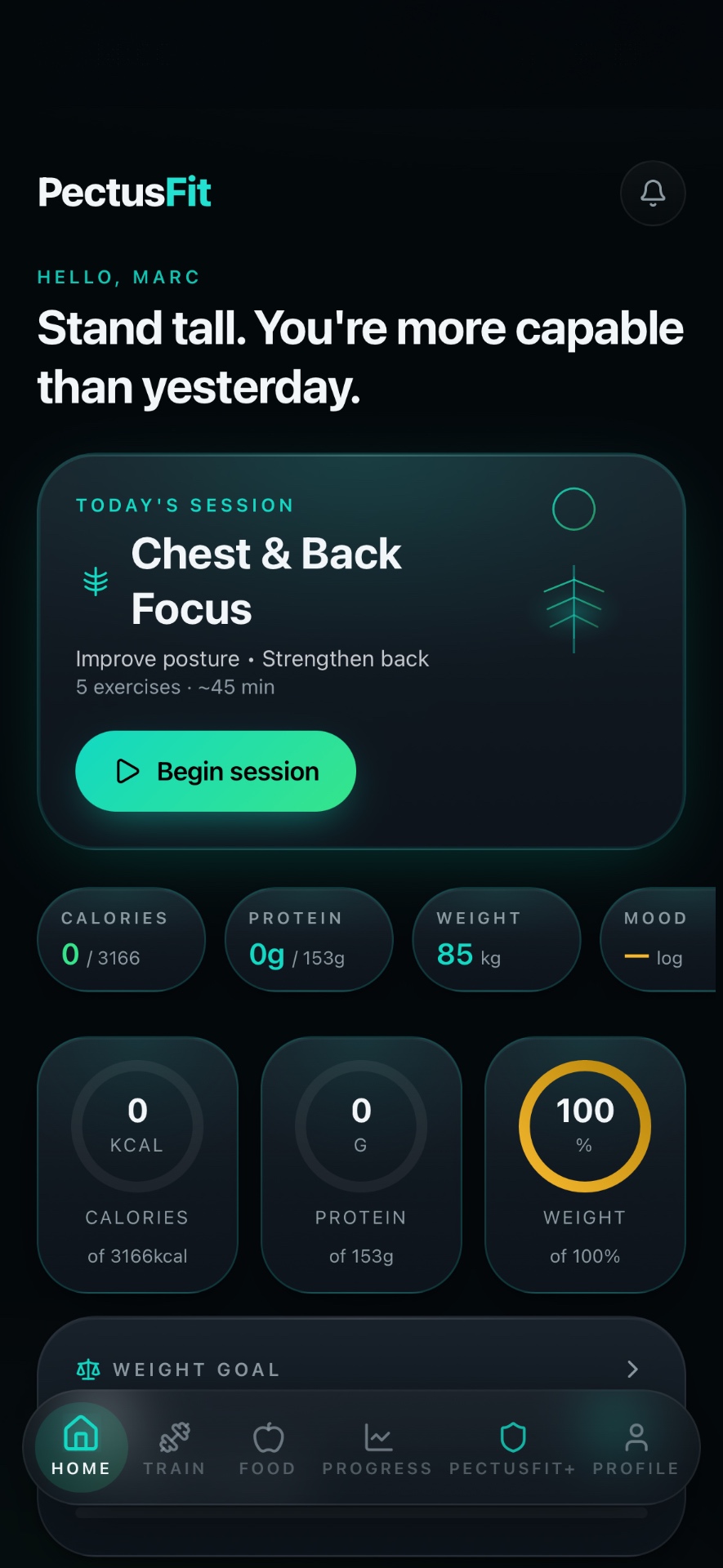
No — you can run the plan from this page. The PectusFit app adds video cues, progression tracking, posture photos, daily mobility, breathing sessions and confidence tools in one place, so you don't have to manage it manually.
Medical disclaimer. PectusFit content is educational and does not replace medical advice. Training may support posture and muscle development, but it does not fix, cure or reverse pectus excavatum. If you experience cardiac, breathing or structural symptoms, consult a qualified healthcare professional.
Train smarter with PectusFit
Personalised plans, posture work, breathing and confidence tools — built for pectus.
Related reading
Pectus exercises
Best Exercises for Pectus Excavatum: Strength, Posture and Confidence
Read articlePectus exercises
How to Gain Muscle with Pectus Excavatum
Read articlePosture
Pectus Posture Exercises: 7 Daily Drills for an Open Chest
Read articlePectus exercises
Can Exercise Improve Pectus Excavatum? An Honest Answer
Read articleBreathing